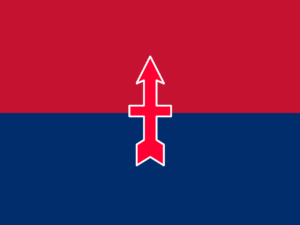
World War One Victory Medal
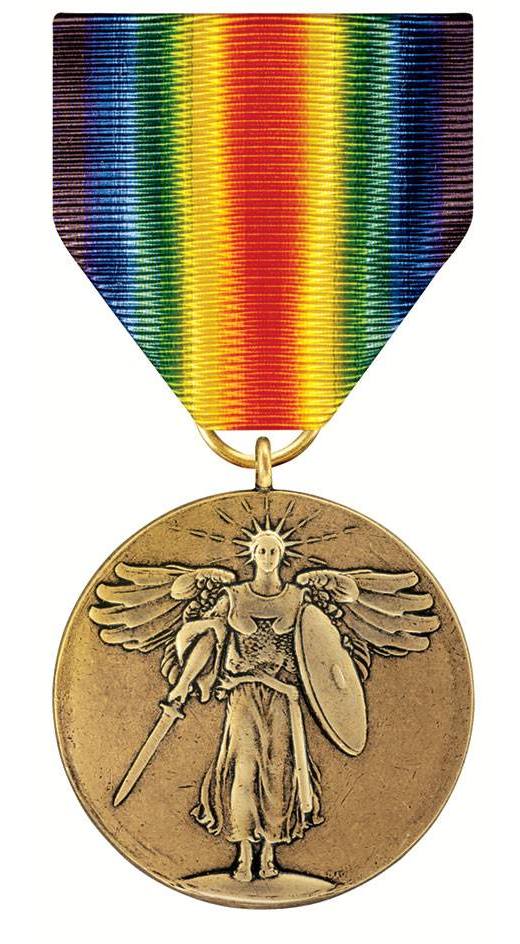
At the end of World War I, the allied nations issued victory medals celebrating the end of the fighting. The decorations record the supreme moment of relief felt by each nation that four years of bloodshed was finally at an end.

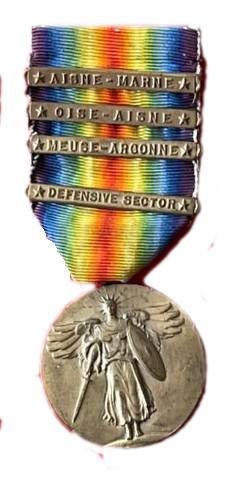
The World War I Victory Medal and the 32nd Infantry Division
When the guns fell silent in 1918, the United States War Department authorized a single, unifying decoration – the World War I Victory Medal – to honor every American who served in the conflict. Cast in bronze, the medal depicts the winged figure of Victory, her right hand clutching a sword and her left an olive branch, symbolizing both martial valor and the hope for peace. The ribbon, a sweeping “rainbow” of eleven stripes in the colors of the Allied powers, was intended to embody the unity of the nations that had stood together against the Central Powers. Though the medal itself was issued universally, each recipient’s ribbon received bronze clasps indicating the specific campaigns or battles in which the individual had taken part, turning a single award into a personalized chronicle of service.
The 32nd Infantry Division – the “Red Arrow” division drawn primarily from the National Guard units of Wisconsin and Michigan – was one of the most heavily decorated formations to receive the Victory Medal. Mobilized in June 1917, the division embarked for France in early 1918 and was promptly thrust into the brutal trench warfare that defined the Western Front. Its soldiers fought ferociously in the final Allied offensives, most notably in the Saint‑Mihiel salient, the Meuse‑Argonne offensive, and the battles of Aisne‑Marne and Champagne. For each of these campaigns a bronze clasp was affixed to the Victory Medal ribbon, creating a visual record of the division’s relentless advance across the devastated French countryside.
Beyond its battlefield exploits, the 32nd earned a reputation for aggressive, forward‑moving tactics – a fighting spirit captured in its enduring nickname, “Red Arrow, Pointing Straight at the Enemy.” The Victory Medal, therefore, became more than a generic token; for the men of the 32nd Infantry Division it was a tangible link between their personal sacrifice and the broader narrative of Allied triumph. In museums and family heirlooms alike, the bronze medallion and its richly colored ribbon stand as a reminder of the division’s contribution to the decisive final year of the Great War and of the collective gratitude of a nation that bestowed it upon those who had proved themselves in the fires of battle.
These medals had a common theme of a winged Victory on the front with an inscription on the reverse with similar wording. The proposal for a common award to be issued by each nation was made by the supreme commander of the Allied Forces, French Marshal Ferdinand Foch. The standard was for a bronze medal 36mm in diameter with double rainbow ribbon, each with a different national design based on the theme of Victory.
Criteria for issuing the medals were different for each country — some only included combatants, while others included anyone involved. The American medal was designed by James Earle Fraser and was authorized in 1919. Its reverse had “The Great War For Civilization” inscribed across the top and a list of the Allied nations on either side of an American shield with a fasces over it (symbolizing peace) and six stars below. Since Congress didn’t fund the medals, they were issued by the Army and Navy departments through general orders and were issued to all servicemen who served between April 6, 1917 and November 11, 1918 and those that served in European Russia or Siberia between November 11, 1918 and April 1, 1920.