

On 10 August 1940, the
Soldiers of the 32D ‘Red Arrow’ Division were working at their
armories throughout Wisconsin and Michigan, completing final preparations for
the annual encampment. This year’s encampment
would be longer-than-normal, for the first time in the history of the National
Guard it would be 3 weeks long instead of the normal 15 days. This year the entire National Guard of the
United States, with a few excepted units, as well as many units from the
Regular Army, would participate in army-level maneuvers at each of the four
army areas throughout the U.S. from 11 to 31 August. [all from this “˅” to its
inverse symbol below was added 2 Nov. ’14, TPB]
While they were packing their gear they were contemplating a piece
of legislation working its way through Congress, legislation that would permit
the mobilization of the entire National Guard, even though the U.S. was not yet
at war, for up to a year for training.
They all understood the unprecedented peacetime mobilization was
designed to improve the training and readiness of the armed forces in general
and the National Guard in specific. What
was less clear, and weighing heavily on some of their minds, was how the
mobilization would impact their civilian lives, whether positive or negative,
in particular the effect on their civilian jobs and their ability to support
their families. They were also thinking
about the news on the radio and in the papers stating this legislation might be
approved by the end of the month, before the end of this year’s encampment.
The 32D Division provided 11,159 of the nearly 70,000
Soldiers who participated in the Second Army Maneuvers, also known as the
Wisconsin Maneuvers, conducted at Camp McCoy, Camp Williams, plus a thousand
square miles of Jackson, Juneau, La Crosse, Monroe, and Wood Counties in
west-central Wisconsin from 11 to 31 August 1940. Second Army consisted of the V Corps
(Indiana, Kentucky, Ohio, West Virginia) and the VI
Corps (Illinois, Michigan, Wisconsin, plus Jefferson Barracks, Missouri). A copy of the maneuver map can be viewed at
the Wisconsin Historical Society
website.
The V Corps, headquartered at Indianapolis, IN, established its
command post at Camp Williams, WI. Some
of its subordinate units included:
The 37TH ‘Buckeye’ Division, Ohio National Guard,
established its assembly and primary training area east of Millston, WI and
north of Warrens, WI.
The 38TH ‘Cyclone’ Division, Indiana, Kentucky, and
West Virginia National Guard, established its assembly and primary training
area between Valley Junction, WI and Norway Ridge, WI.
The 5TH ‘Red Diamond’ Division, Regular Army, from Fort
Benjamin Harrison, IN, established its assembly area east of Shamrock, WI. Recently converted to the new “triangular”
division MTOE, it was one of the Army’s most modern, streamlined
divisions. This division, reinforced
with several attached units, was the primary opposing force or aggressor force
during the maneuvers.
The 7TH Cavalry Brigade (Mechanized), Regular Army,
from Fort Knox, KY, established its assembly area was just northeast of Camp
Williams. This was the Army’s premier
armored unit at the time. Not too long
after these maneuvers it formed the nucleus of the 1ST Armored
Division.
The 107TH Cavalry Regiment, Ohio National Guard,
participated in the maneuvers but its assembly area was not indicated on the
map I found. They may have encamped with
their cavalry brethren during the maneuvers, for they detrained at Wyeville, WI, not far from the 53D Cav. Bde. assembly area.
The VI Corps, headquartered at Chicago, IL, established their
command post just east of what was then the main post of Camp McCoy, WI. When the new and current main post of Fort
McCoy was built in 1942 during the WWII expansion, the original main post
became known as Old Camp McCoy. Sometime
after the war those buildings were sold off; Fort McCoy’s current housing area
is located where the old main post once stood.
Some of its subordinate units included:
The 32D ‘Red Arrow’ Division’s assembly and primary
training area was north of Camp McCoy, WI, where Fort McCoy’s main post is now,
but in Aug. ’40 that land was not part of the military reservation yet.
The 33D ‘Prairie’ Division, Illinois National Guard,
established its assembly and primary training area just south of Camp McCoy,
WI.
The 53D Cavalry Brigade, Illinois, Michigan and
Wisconsin National Guard, established its assembly area between Valley
Junction, WI and Norway Ridge, WI.
The 53D Cav. Bde. consisted of
the 105TH Cavalry Regiment, Wisconsin National Guard, and the 106TH
Cavalry Regiment, Illinois and Michigan National Guard.
It is interesting to note the commander of the 53D Cav.
Bde. was Brig. Gen. Ralph M. Immell, who was also the
Adjutant General for Wisconsin.
The 8TH Illinois Infantry Regiment, Illinois National
Guard, participated in the maneuvers but its assembly area was not shown on the
map that I found. The 8TH
Ill. Inf. reinforced the 5TH Div. during some, if not all, of the
maneuvers, so its assembly area may have been close to the 5TH Div.
near Shamrock, WI.
The 8TH Ill. Inf. was an African-American unit,
originally organized 4 November 1895 as 4TH Battalion, 5TH
Illinois Infantry. It was the 8TH
Ill. Inf. by the time of the Spanish-American War, during which it served in
combat in Cuba. It fought in France as
the 370TH Inf. during WWI. It
was one of very few National Guard units in the U.S. which were allowed to keep
their historic unit designations after WWI.
The 61ST Anti-aircraft Regiment, Regular Army, from
Fort Sheridan, IL, participated in the maneuvers but its assembly area was not
shown on the map that I found. They
reinforced the 5TH Div. in the opposing force, or aggressor force,
role.
The 14TH Cavalry Squadron, Regular Army, from
Fort Sheridan, IL, was attached to the 53D Cav. Bde. for some, if not all, of the exercises.
The 23D Reconnaissance Squadron (Motorized), Illinois
National Guard, participated in the maneuvers but their assembly area was not
shown on the map that I found. They were
a scout car equipped cavalry unit organized earlier that year in Springfield,
IL. They were attached to the 53D
Cav. Bde. but they routinely reinforced the 5TH
Div. in the opposing force, or aggressor force, role.
The 15TH Observation Squadron, Regular Army Air Corps,
from Scott Field, IL, participated in the maneuvers. They likely operated out of the airport at La
Crosse, WI, as did the 32D Division’s 107TH Observation
Squadron. There is a good chance the 108TH,
112TH and 113TH Observation Squadrons, from the 33D,
37TH and 38TH Divisions respectively, operated out of La
Crosse as well; there were not many airfields in the area in 1940. The 15TH Obs. Sqdn. primarily, if
not exclusively, reinforced the 5TH Div. in the opposing force, or
aggressor force, role.
The Army, to include the reserve components, had been conducting
larger and larger maneuvers for the past several years, but these 1940
maneuvers were of a size, scope, and intensity the National Guard had not
experienced before. The Regular Army
itself had only conducted its first serious corps maneuvers earlier that
spring. There were numerous objectives
for the maneuvers; the primary goals being to assess the training status of the
National Guard, appraise the leadership ability at the upper echelons, and to
increase the tactical proficiency of the National Guard. The maneuvers also served as an introduction
to the latest mobile warfare concepts being studied and adopted by the Army,
largely based on lessons learned from the war raging on the other side of the
world.
Training started at the individual and small unit level, and then
rapidly progressed through the echelons from battalion to corps. The pinnacle of the maneuvers was a 3-day
corps versus corps engagement at the end of the encampment. Even at 21 days in length, the encampment
only allowed a couple of days’ training at each of the echelons.
The 64TH Inf. Bde. arrived
in camp on 11 August, their first
training event the next morning took them to the rifle ranges where they
received an introduction to the Army’s new service rifle, the M-1 Garand. It would still be a while before they would
be issued the new rifle though; National Guard units, and some Regular Army
units, were still using the M-1903 Springfield rifle. The M-1903 was a good rifle, but it was
clearly outclassed by some of the rifles being used by other armies in actual
combat at the time. The other infantry
units likely received similar introductory training on the M-1.
Rifles were not the only equipment deficiency faced by the
National Guard when they went up against the Regular Army units, who were
equipped with the latest, modern equipment in the American arsenal: “Virtually
every type of equipment was obsolete, or scarce, or both. Guardsmen reported to their encampments with
World War I tents, webbing, shoes, and blankets in various stages of
decay. Their khaki clothing looked old
and worn even before field maneuvers began.
News correspondents (147 at First Army’s encampment alone) who covered
the August maneuvers paid particular attention to the numerous items of
equipment that the National Guard did not have at all. A shocked public read about trucks with
“TANK” painted on the sides, Springfield rifles labeled “.50 CALIBRE,” and
simulated antitank guns constructed of drainpipe. (Gabel 13-14)”
Speaking of tanks, each of the “square” National Guard
infantry divisions was authorized seventeen tanks for the tank company assigned
to each division; the 32D and 33D Infantry Divisions had
but two M-2 light tanks apiece. The 37TH
and 38TH Divisions were almost certainly in the same position
regarding tanks. The tank companies
could only be deployed as a tank platoons throughout the exercises, with two
actual tanks trailed by a truck hauling the twelve Soldiers who were supposed
to man the other three tanks, had they been issued in accordance with the MTOE.
The M-2 light tank, equipped with
one .50 caliber and one .30 caliber machinegun, was nicknamed the ‘Mae West,’
on account of its twin turrets.
An editorial in the Chicago Daily Tribune on 27 August, labeled “Tanks in the
Wisconsin Maneuvers,” offered a terse opinion of the equipment shortage endured
by the National Guard: “The maneuvers have shown the army making an
intelligent effort at experiment in the use of armored columns. The tanks, of
course, are purely imaginary, consisting of trucks designated as tanks. The
country would feel more secure if the war mongers in Washington would leave off
bawling for conscription long enough to provide modern weapons for the troops
we already have.” Legislation to
permit an unprecedented peacetime draft was working its way through Congress at
the same time as the legislation to activate the National Guard in peacetime.
The scope of these unprecedented maneuvers were a test for
America’s railroads as well, the largest mass troop movement since World War
I. While some units made the trip by
motor convoy, 300,000 Soldiers and their equipment had to be transported from
all over the country to their assigned maneuver areas in the span of a few
days, with the process repeated in reverse at the end of the exercise. The U.S. massive, efficient railroad networked
encountered little difficulty in meeting the extraordinary demands.
President Franklin D. Roosevelt signed Public Resolution No. 96,
76th Congress, into law on 27 August
1940, four days before the end of the nationwide 21-day army
maneuvers. The document granted him
authority to order units and individuals of the Army’s reserve components to
active duty for up to a year, with the stipulation that they could not deploy
outside the Western Hemisphere, unless it was to a U.S. territory or
possession. [all from this “˄” to its inverse symbol above was added 2 Nov. ’14, TPB]
All 18 existing National Guard divisions, plus countless, smaller,
non-divisional units, would be called up in the months that followed; the 32D
‘Red Arrow’ Infantry Division was among the first. The National Guard of the United States was
activated in 20 increments between 16 Sept. 1940 and 23 June 1941.
On 25 September 1940,
President Roosevelt ordered 35,700 National Guard officers and men to active
duty, with a report date of 15 October.
This was the second increment of National Guard mobilizations and
included the 32D Division, minus the 32D Tank Company
which would be detached from the Div. and mobilized separately a few weeks
later. The order included the
announcement that the Division would train at Camp Beauregard, LA. [added 27 Apr. ’14, TPB]
Other units in this executive order were:
The 27TH ‘New York’ Division, New York National Guard,
minus its tank company; they would train at Ft. McClellan, AL.
The 37TH ‘Buckeye’ Division, Ohio National Guard, minus
its tank company as well as Co. F and Co. I, 112TH
Med. Regt. They would train at Camp
Shelby, MS.
The 102D Observation Squadron, New York National Guard,
which would train at Ft. McClellan, AL.
The 153D Observation Squadron, Mississippi National
Guard, which would train at its home station in Meridian, MS.
The 107TH Observation Squadron, Michigan National
Guard, which would train at Camp Beauregard, LA.
Since its post-WWI reorganization and Federal recognition in May
of 1926 the 107TH had been organic to the 32D Division,
however it was detached from the Div. when it was activated and came under
control of the Regular Army. “The
War Department was in alarm over the extent to which mechanized armor and
military aviation had been neglected [in the Regular Army]. In a desperate, eleventh-hour effort to
remedy the situation, all the National Guard Divisional Tank units and the
Divisional Air Observation Squadrons were ordered to active duty as
non-divisional troops and quite often sent to a different camp, or even a
different Corps area, from that of the parent Division. (Hill 532)”
[added
27 Apr. ’14, TPB]
Almost overnight the Army Air Corps grew from 55 air squadrons to
84. However, all 29 of the newly added
National Guard aviation units were observation squadrons, the Air Corps did not
need that many observation squadrons, they already had
10 to begin with. Most of the old
National Guard observation squadrons would be converted to perform different
missions, about two thirds of them would keep their original unit number, but a
third of them would lose that too. [added 27 Apr. ’14,
TPB]
The 107TH retained its original unit number, but it
would be converted to a photo reconnaissance squadron. Deployed to England in Aug. ’42, it flew
British Spitfires for about a year until the arrival of its new F-6As, a photo
reconnaissance variant of the P-51 ‘Mustang’. [added 27 Apr. ’14,
TPB]
The Wisconsin National Guard’s 126TH Observation
Squadron would become the 34TH Photo Reconnaissance Squadron (the
126TH was not organic to the 32D Division, it was a
corps-level asset). [added 27 Apr. ’14, TPB]
On 15 October 1940, the 32D
‘Red Arrow’ Division, consisting of National Guard units from Michigan and
Wisconsin, was called to active duty.
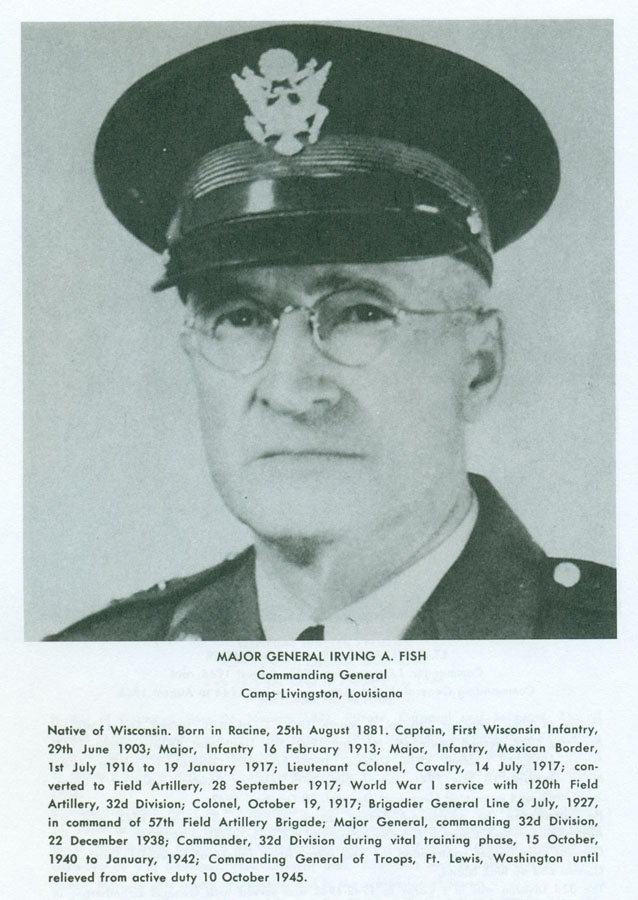
| The Division was commanded by Major General Irving J. Fish and |
“See You In a Year”
copyrighted image
“Honoring Those Who Have Served through Art”
A.M. Stencel
Stencel
Military Fine Art
When the Division was called up, it was basically
the same “square” division that it was during World War I. It was centered around
the 125TH and 126TH Infantry Regiments of the 63D
Infantry Brigade from Michigan and the 127TH and 128TH
Infantry Regiments of the 64TH Infantry Brigade from Wisconsin. The 32D
Division’s 57TH Field Artillery Brigade was comprised of the 120TH,
the 121ST and the 126TH Artillery Regiments of the
Wisconsin National Guard.
The 119TH Field Artillery Regiment of the Michigan National
Guard had recently been detached from the 32D Division and assigned
to the 72D Field Artillery Brigade, headquartered in Michigan. The 72D Field Artillery Brigade
included the 182D Field Artillery, 177TH Field Artillery,
and 119TH Field Artillery, all Michigan National Guard. The 126TH Field Artillery, which
took the place of the 119TH Field Artillery in the 57TH
Field Artillery Brigade, had recently been converted from the 105TH
Cavalry Regiment of the Wisconsin National Guard.Some of the major unit commanders at this time included:
63D Infantry Brigade – Brigadier General Thomas
Colladay, from Detroit, MI
125TH Infantry Regiment – Colonel Matthias A. Wiesenhoefer,
from Detroit, MI
126TH Infantry Regiment – Colonel William Haze, from
Grand Rapids, MI
64TH Infantry Brigade – Brigadier General Paul Bernard Clemens, from
Milwaukee, WI
127TH Infantry Regiment – Colonel Forrest Hale
Himes, from Crandon, WI
128TH Infantry Regiment – Colonel William A.
Holden, from King, WI
57TH Field Artillery Brigade – Brigadier General William Squire
Wood, Jr., from Beloit, WI
120TH Field Artillery Regiment – Colonel Jim Dan
Hill, from Superior, WI
121ST Field Artillery Regiment – Colonel Waldemar
F. Breidster, from Milwaukee, WI
126TH Field Artillery Regiment – Colonel
Frederick C. T. John, from Milwaukee, WI107TH Engineer Regiment, Colonel Ralph A. Loveland,
from Ann Arbor, MI107TH Medical Regiment, Colonel John Dale Buck, from
Detroit, MI107TH Quartermaster Regiment, Colonel John C. P.
Hanley, Chilton, WI
On 20 October Lt. Col. J. Tracy Hale, Jr. succeeded Col.
Himes as commander 127TH Infantry.
Col. Himes had enlisted in Co. L, 2D Wis. Inf.,
Wisconsin National Guard, at Rhinelander, WI in ’07. He was promoted 1st Lt. on 13 May ’10. He served as Capt. and commander of Co. L, 2D
Wis. Inf. during the Mexican Border Crisis and when it mobilized again on 15
Jul. ’17. He was assigned as commander
of Co. L when the 127TH Inf. was organized. He was Maj. in HQ, 127TH Inf. on 1
Apr. ’21. He was Col. and commander of
127TH Inf. when 32D Div. mobilized on 15 Oct. ’40; he had
been commander since at least ’30. After
he relinquished command, he helped organized the Wisconsin State Guard and
assumed command of the 2D Regt., Wis. State Guard. His son, 1st Lt. Thomas F. Himes, assigned to
the 317TH Inf., 80TH Inf. Div., was KIA 25 Sep. ’44 in
France. Col. Himes passed away 23 Jul.
’63 and is interred at Crandon Lakeside Cemetery, Crandon, WI.
During the last week or so of October 1940,
the Division was shipped to Camp Beauregard, Louisiana. Most of the personnel and equipment were
shipped by rail, but some advance detachments went by motor convoy.
The Division suffered its
first casualty in one such convoy when Pvt. Donald George Henry, from Wisconsin
Rapids, WI, died after being struck by a drunk driver at 1110 hours on 22 October at Covington, TN. He was one of several Soldiers, riding their
own motorcycles, who were detailed to serve as dispatch riders and traffic
guides for the convoy bound for Camp Beauregard, LA. The car driver, William Ford, had narrowly
missed a couple of vehicles in the convoy before colliding with Pvt.
Henry. The impact caused the motorcycle
to become imbedded in the car; the two moved as one while the car spun several
times. The motorcycle was dislodged when
the car rolled. Henry was thrown inside
the car; he suffered head injuries and a broken neck. He expired in the ambulance enroute to a
hospital in nearby Ripley, TN. Ford
escaped serious injury and was immediately arrested, a case of liquor was found
in his car. He was supposedly charged
with second degree murder. He,
reportedly, had to be moved from the local jail to another location. The local populace being incensed by what he
had done; there were threats he might be lynched. Pvt. Henry had enlisted in his local
Wisconsin National Guard unit, Btry. E, 120TH FA Regt., at Wisconsin
Rapids, WI, shortly before they mobilized on 15 October. [added 24 Mar. ’14, TPB]
Late in the afternoon of 22
October, the 81 officers and Soldiers then assigned to Co. E, 127TH
Inf. marched from their brand new armory at the fairgrounds in Manitowoc, WI to
the Chicago & North Western (C&NW) railroad depot. They were escorted by the local Marine Band. At the depot they embarked a special train
which included Pullmans, diners, and baggage cars the trip to Camp Beauregard. [added 25 Dec. ’13, TPB]Also on 22 October, Co.
G, 127TH Inf. departed from the Milwaukee Road railroad depot at
Oconomowoc, WI at 2030 hours aboard a 12-car train bound for Camp
Beauregard. A crowd of 4,000 citizens
turned out see them off; the community had a population of 4,562 people in ’40.
[added 15 Dec. ’13, TPB]Co. I, 127TH Inf., and the HQ Cos. of both the 1ST
and 3D Bns. of the 127TH Inf., departed the Twin Cities
of Menasha and Neenah, WI, bound for Camp Beauregard, on 22 October. A newspaper
article in the Menasha Record on 20 October 1943, commemorating the 3rd
anniversary of their mobilization for WWII, recalled that “The boys were given a rousing
sendoff by the cities of Menasha and Neenah, whose people gathered upon the
streets to see them on parade as they marched to the [Chicago &
North Western (C&NW)] depot for entrainment to the southern
camp.” [added 29 Apr. ’13, TPB]On 23 October, HQ Det.,
3D Bn., 125TH Inf., and Co. L, 125TH Inf.,
departed Port Huron, MI, aboard a Grand Trunk Western (GTW) train at 1850 hours
for Camp Beauregard. The units formed in
front of their armory on Broad St. at 1730 hours and, escorted by the Port
Huron City Band, “marched along Broad St. to Huron Ave. and then south along Huron Ave.
and Military St. to Court St., east to 4th St. and a block south to the”
Tunnel Station. A crowd of 10,000 turned
out to see them off. [added 25 Aug. ‘18, TPB]The Port Huron units received a unique send-off in the form of a
telegram from Mickey Rooney. The young
actor had visited Port Huron for the world premiere of his movie Young Tom Edison, on 10 Feb. ‘40. He sent a telegram to Capt. O. D. Brown which
said: “Warm spot in my heart for your reception to my Young Tom Edison
premiere last February. Am sure when you
strike up the band and go south they will welcome you as warmly as you did me.” [added 25 Aug. ‘18,
TPB]On 25 October, Co. A,
126TH Inf., boarded a train at Coldwater, MI, bound for Camp
Beauregard. [added 29 Mar. ’17, TPB]That process was repeated for 157 company-size units in 83
communities from Abbotsford, Wisconsin to Ypsilanti, Michigan at the end of
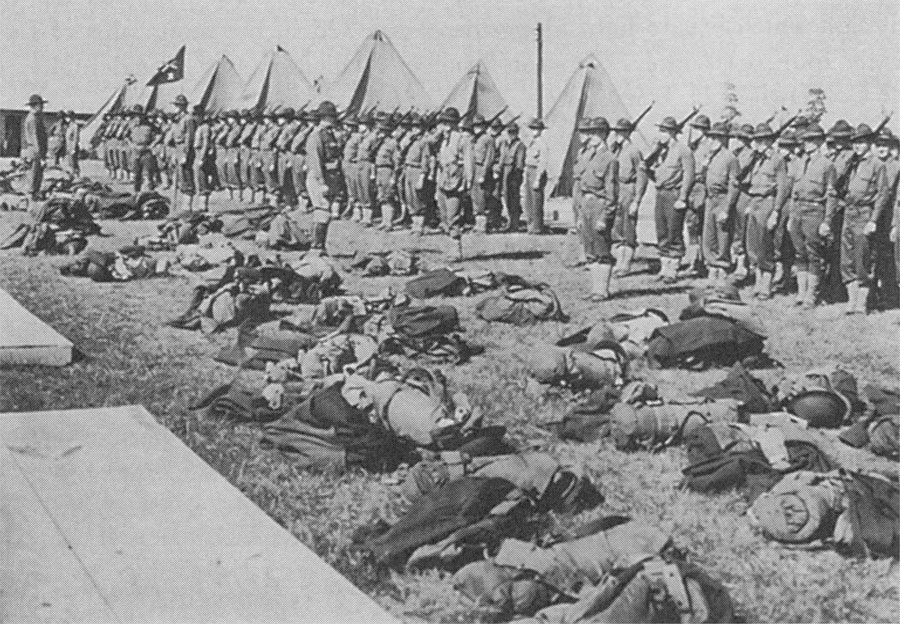
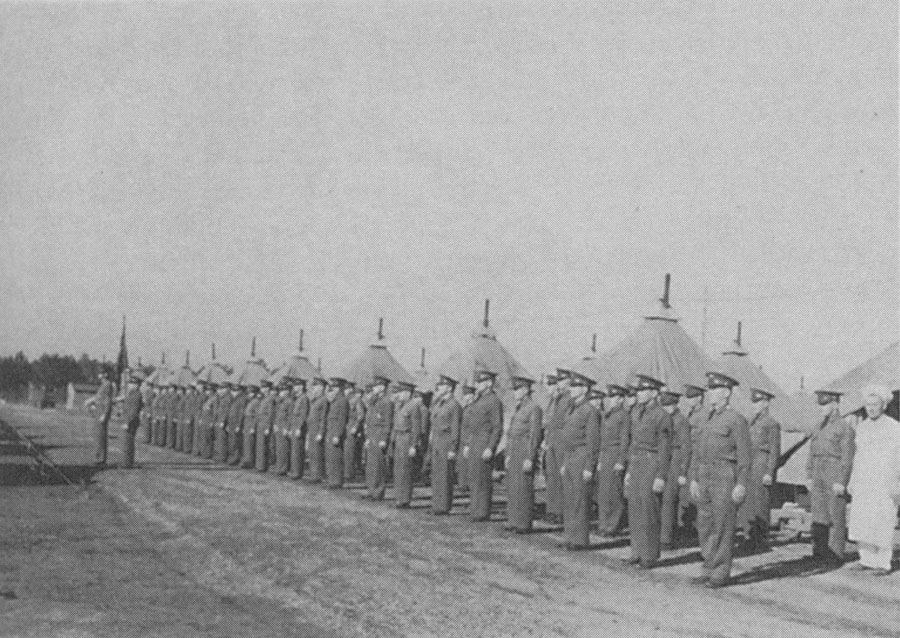
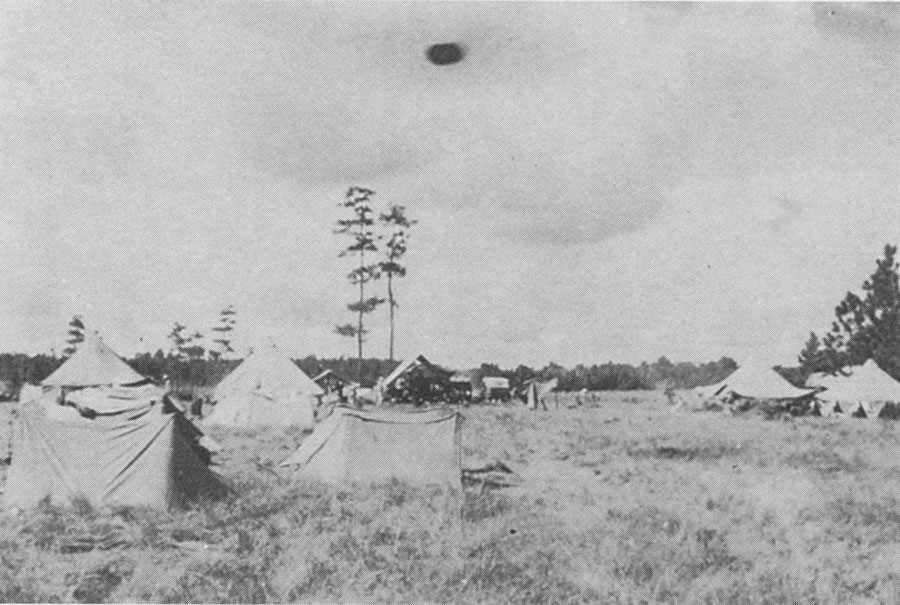
Oct. ‘40. [added 29 Apr. ’13, TPB]The living conditions for the soldiers at Camp Beauregard were
less-than-ideal, so some soldiers un-affectionately nicknamed it ‘Camp Disregard.’ The poor living conditions were partly the result of the fact that the camp was designed to accommodate
one regiment, but the entire 32D Division was sent there anyway.




In mid-October 1941 the 192D
Tank Battalion, including the former 32D Division
Tank Company (now Co. A of the 192D), was moved by rail to San
Francisco, California. The 192D was sent to the Philippines, where with the 194TH Tank Battalion became the Provisional Tank Group on Luzon.
This Tank Group included the tank companies from the National Guard
Divisions from California (40TH), Kentucky (38TH),
Illinois (33D), Minnesota (34TH), Ohio (37TH)
and Wisconsin (32D).
Prior to the creation of the 1ST and 2D
Armored Divisions on 15 July 1940, the only armored force the US Regular Army
had was an experimental Mechanized Cavalry Brigade at Fort Knox, Kentucky. Just prior to the induction of the National
Guard divisions, their organic tank companies were declared non-divisional GHQ
(General Headquarters) Troops. As a
result, each division was stripped of its tank company and those companies now
came under the direct control of the new and growing Armored Force, with then
Brig. Gen. Adna R. Chaffee as its first Chief. When it was recognized that US forces in the
Philippines needed some tanks for a more balanced force against the rising
threat from Japan, Brig. Gen. Chaffee selected the 6 National Guard tank
companies mentioned above. The tank
companies of the 18 National Guard Divisions represented the oldest,
most-experienced, and best-equipped armored units in being in the US. These National Guard tank companies had been
training with World War I French tanks (FT-17) up until about 1940 and only now
were being equipped with the M-3 light tank.
On 31 October 1941, the 3,500-man 128TH
Infantry Regimental Combat Team departed Camp Livingston in a convoy of about
500 trucks bound for Fort Jackson, SC, to participate in the First Army
Carolina maneuvers (held later in November). The unit was commanded by Col. William
A. Holden. Its major units included: 1ST
Bn., 127TH Inf., commanded by Lt. Col. William A. Draheim, from
Neenah, WI; 2D Bn., 128TH Inf., Lt. Col. Herbert A.
Smith, from Oshkosh, WI; 3D Bn., 125TH Inf., Maj. Brice
C. W. Custer, from Detroit, MI; det. from 107TH QM Regt., Capt.
Lester Warner Schuler, from Janesville, WI; a bn. from 120TH FA,
Maj. Kenneth J. Hough, from La Crosse, WI, and 2 companies from 107TH Med.
Regt. from MI. Stops along the 1,000-mile route
included Jackson, MS, Selma, AL, and Fort Benning, GA where a brief, impromptu
reunion occurred with some officers from the Div. who were training there. [updated 20
Oct. ’14, TPB]
Maj.
Brice C. W. Custer was supply officer in 125TH Inf., Michigan
National Guard, when 32D Div. mobilized on 15 Oct. ’40. His brother, Cpt. Charles A. Custer, was
commander of Co. C, 125TH Inf. on 15 Oct. ’40. Both officers were from Monroe, MI and were
grand-nephews of Gen. George Armstrong Custer.
Both would end up serving with other units in the European Theater
because of the looming “triangularization” of the 32D Div. about to
be described below. Brice would serve as
commander of 1ST Bn., 232D Inf., 42D
Div. across France, Germany and Austria.
Lt. Col. Custer would earn the Silver Star for his actions 6 Jan. ’45
near Stadtmatten, France; he would personally
organize and lead an ad hoc force to rescue 2 platoons from his Bn. when they
become cutoff by the Germans.
[added 20 Oct. ’14, TPB]
Capt.
Lester W. Schuler was commander of Co. B, 107TH QM Regt., Wisconsin
National Guard, at Janesville, WI when it was first organized in ’38 and when
it mobilized on 15 Oct. ’40. Earlier he
had commanded the 32D Tank Co. at Janesville, in ’30s. Due to the looming “triangularization” of the
32D Div. about to be described below, Co. B converted to Co. A, 150TH
Light Maint. Bn. and served in the European Theater. [added 20 Oct.
’14, TPB]
On 13 November, Brig. Gen. William S.
Wood, Jr. resigned so he could return to his civilian job as vice-president and
general manager of Beloit Iron Works (later Beloit Corp.), which was starting
to receive numerous defense contracts.
He was succeeded by Brig. Gen. Ellerbe W. Carter, from Louisville, KY,
as commander of the 57TH Field Artillery Brigade.
Brig. Gen. Wood had graduated USMA
at West Point in ’20. After being
stationed in France for a year, he transferred to Ft. Knox, KY where he met his
wife, father of at least 3. He then
served with 3D FA Regt. at Schofield Barracks, HI; other assignments
included Ft. Sam Houston, TX and Jefferson Barracks, MO. He resigned from Regular Army in ’28 or ’29
and joined Wisconsin National Guard.
Col. Wood became commander of newly formed 126TH FA Regt.,
converted from 105TH Cav., in ’40.
He was promoted to Brig. Gen. ca. Oct. ’40 at
age 43, one of the youngest to hold that rank.
He was commander of the 57TH FA Bde. at
Milwaukee, WI when 32D Div. mobilized on 15 Oct. ’40. He worked at Beloit Corp. until retirement;
retired to a farm in WI, then moved to FL, later returned to Beloit. He passed away 6 Nov. ’75 at Beloit, WI and
is interred at Oak Hill Cemetery, Janesville, WI. [added 23 Oct. ’14, TPB]
Brig. Gen. Carter had enlisted in 1ST
Ky. Inf., Kentucky National Guard, in ’11.
Promoted Capt. by ’15, he commanded Co. B, 1ST Ky. Inf.,
during the Mexican Border Crisis, stationed at Camp Owen Bierne,
about 2 miles from Fort Bliss. He was
assigned to the 138TH FA Regt. when 38TH Div. was
organized at Camp Shelby, MS for WWI.
Promoted Maj. on 16 Jul. ’18.
Promoted Brig. Gen. in ’23 and commanded the 63D FA Bde. from 3 Mar. ’23 to Oct. ’41.
After the 32D Div. was “triangularized,” he was assigned
commander of 7TH Div. Arty., ’42-’43. He was Asst. CG of FA Recruit Training
Command, Ft. Bragg, NC, ’43-’46. He retired from the military in ’48. Married twice and father of 11, he passed
away 11 Oct. ’72 and is interred at Oaklawn Memorial
Gardens, Titusville, FL.
[added 23 Oct. ’14, TPB]
At about the same time, Lt. Col. Kenneth L. Hallenbeck,
from Ann Arbor, MI, became the commander of the 125TH Infantry,
taking the place of Col. Matthias A. Wiesenhoefer.
Col. Wiesenhoefer, a WWI veteran, was
Capt. and commander of Co. B, 125TH Inf., Michigan National Guard,
at Detroit, MI when it received Federal Recognition on 30 Apr. ’20 during the
post-WWI reorganization of the 32D Div. He was Col. and commander of 125TH
Inf. when the 32D Div. mobilized on 15 Oct. ’40. Not sure what he did after he left the 125TH
Inf. He passed away 22 Dec. ’56 and is
interred at Saint Francis Cemetery, Phoenix, AZ. [added 23 Oct. ’14, TPB]
Then Capt. Hallenbeck was commander of Co. K, 125TH
Inf., Michigan National Guard, at Ann Arbor, MI ca. ’32. He was Maj. and Asst. G-3 at HQ, 32D
Div. at Lansing, MI when 32D Div. mobilized on 15 Oct. ’40. Not sure what he did after the 32D Div. was “triangularized,” but Col. Hallenbeck
continued to serve with the post-war Mich. Nat. Guard and attained the rank of
Brig. Gen. before he retired ca. ’60. He
was namesake of the Gen. Hallenbeck Award, a Mich. Nat. Guard award bestowed by
3D Bde., 46TH Inf. Div. during
annual training in the ’60s. Married and
father of two, he passed away 13 Sep. ’75 at Dearborn, MI at age 74 and is
interred at Forest Hill Cemetery, Ann Arbor, MI. [added 23 Oct. ’14, TPB]
On 3 December
1941 the 632D Tank Destroyer Battalion was formed at Camp
Livingston, Louisiana from personnel of the 32D Infantry Division.
When the ‘square’ National Guard divisions were
“triangularized,” each was required to create one tank destroyer battalion from
surplus units (for some reason, the 41ST Division was not tasked
with this requirement). These battalions
were numbered in the 600-series with the last 2 digits indicating the division
it came from. There were 7 additional
tank destroyer battalions created from the 7 brigades of National Guard corps
artillery. They were numbered in the
700-series with the last 2 digits indicating the brigade it was created
from. These battalions were
non-divisional units; they were GHQ Troops under the control of the Armored
Force, so technically they were not organic to the parent unit. However, some of these tank destroyer
battalions went overseas and served closely with the parent unit. Most were separated, some were re-designated
to become part of an armored division, and others were inactivated with their
personnel absorbed into some other Armored Force unit.
The 632D Tank Destroyer Battalion served closely with the 32D Division. It went
to Australia with the 32D Division. It fought with the 32D at Aitape and Saidor.
It went into the battle for Leyte with the 1ST Cavalry
Division, but later joined the 32D
on Leyte. On Luzon it was initially
attached to the 13TH Armored Group but subsequently served with 37TH,
44TH and 32D Divisions on
Luzon.
On 7 December 1941, in conjunction with the attack on Pearl
Harbor, the Japanese began bombing the Philippines in preparation for an
amphibious assault a few days later.
Company A, 192D Tank Battalion (formerly the 32D
Div. Tank Co.) fought against the Imperial Japanese Forces in many engagements
and rear guard actions, and rendered assistance in covering the eventual
retreat of our forces into Bataan.
Wisconsin’s Governor Julius P. Heil visited the
Soldiers of the 32D Infantry Division at Camp Livingston, LA on 10 December. [added 27 Aug.
’13, TPB]
On 1 February 1942, the 32D Division was reorganized into a “triangular” division,
centered around three infantry regiments instead of
four. This change affected all National
Guard divisions (the Regular Army divisions had been “triangularized” starting
1 Nov. ‘40). Obviously a reorganization
of this size and scope was not completed in one day; 1 February is simply the
official, effective date of the reorganization.
The 32D and 37TH
Divisions were the first National Guard divisions to convert on 1 February 1942;
the conversion of the other National Guard divisions was staggered between that
day and 1 September 1942. With this
reorganization, all divisional infantry brigade headquarters (with one
exception) were disbanded. One infantry
brigade headquarters company from each division was converted and re-designated
as the division reconnaissance troop (with two exceptions). The headquarters and headquarters battery of
each divisional field artillery brigade was reorganized as the division
artillery headquarters and headquarters battery. Other divisional elements were reorganized,
re-designated, reassigned, or disbanded.
As a result, the 125TH
Infantry Regiment was detached from the Division and assigned to Fourth Army to
expand the forces defending the West Coast.
The three existing
artillery regiments (120TH, 121ST and 126TH)
were converted into four battalions (120TH, 121ST, 126TH
and 129TH; three battalions of 105mm howitzers and one battalion of
155mm howitzers).
The 1ST Battalion, 120TH Field
Artillery Regiment became the 120TH Field Artillery Battalion, 105mm
howitzer, track-drawn, on 31 January 1942.The 2D Battalion, 120TH
Field Artillery Regiment became the 129TH Field Artillery Battalion,
105mm howitzer, track-drawn, on 31 January 1942.The 1ST Battalion, 121ST
Field Artillery Regiment became the 121ST Field Artillery Battalion,
155mm howitzer, track-drawn, on 16 January 1942.The 1ST Battalion, 126TH
Field Artillery Regiment became the 126TH Field Artillery Battalion,
105mm howitzer, truck-drawn, on 31 January 1942.
The 2D Battalions of the 121ST
and 126TH Field Artillery Regiments were combined to form the 173D
Field Artillery Regiment, 155mm, motorized.
COL Waldemar F. Breidster assumed command of the new unit; he had been
the commander of the 121ST Field Artillery Regiment. [updated 28
Apr. ’14, TPB]
The 2D Battalion, 126TH
Field Artillery Regiment became the 1ST Battalion, 173D
Field Artillery Regiment on 16 Jan. ’42.The 2D Battalion, 121ST
Field Artillery Regiment became 2D Battalion, 173D Field
Artillery Regiment on 16 Jan. ‘42. [updated 28 Apr. ’14, TPB]
The engineer, medical and quartermaster regiments were also
converted into battalions as part of the reorganization to a “triangular”
division.
The 1ST Battalion, 107TH Engineer Regiment
became the 107TH Engineer Battalion; the 2D Battalion
became the 131ST Engineer Battalion, on 16 January 1942.
When the reorganization was complete, the 32D ‘Red
Arrow’ Infantry Division consisted of the following units:
Division Headquarters and Headquarters Company
Military Police Company
126TH Infantry Regiment
127TH Infantry Regiment
128TH Infantry Regiment
Division Artillery Headquarters and Headquarters
Battery (formerly HHB, 57TH FA Bde.)
120TH Field Artillery Battalion, Lt. Col.
Harold A. Morgan, from Merrill, WI
121ST Field Artillery Battalion, Lt.
Col. Melvin Leslie McCreary, from Milwaukee, WI
126TH Field Artillery Battalion, Lt.
Col. Ross J. Quatsoe, from De Pere, WI
129TH Field Artillery Battalion, Col.
Ralph A. Loveland, from Ann Arbor, MI
107TH Medical Battalion, Lt. Col. Carl Hanna, from Detroit, MI
107TH Quartermaster Battalion, Lt. Col. Donald M. Farris, from
Madison, WI
32D Signal Company
32D Cavalry Reconnaissance Troop (formerly HQ, 64TH Inf.
Bde.) [updated
28 Apr. ’14, TPB]
632D Tank Destroyer Battalion (not organic to the Division), Maj.
Roy William Bailey, from Eau Claire, WI
The drastic reorganization meant that thousands of the Division’s
soldiers and officers were now excess, and their pending loss was difficult for
many at first. Many of these men were
National Guard Soldiers from Michigan and Wisconsin who had served with the 32D
Division for years. Some of them,
especially junior enlisted and junior officers, could be transferred to fill
vacancies within the Division. For many,
the only option was a transfer to some other unit outside the Division.
Only two of the Division’s original full-bird Colonels remained
after the reorganization. Col. J. Tracy
Hale, Jr., from Milwaukee, remained commander of the 127TH
Infantry. Col. Frederick C. T. John,
from Milwaukee, had been the commander of the 126TH FA Regt., not
sure what his new duty position was.
Col. John C. P. Hanley and Lt. Col. Sylvester S. Zintek were transferred to the 28TH ‘Keystone’
Infantry Division, Pennsylvania National Guard, then training at nearby Camp
Beauregard, LA. Both had been with the
Wisconsin National Guard for many years, Col. Hanley resided at Chilton,
Wisconsin, and had commanded the 107TH Quartermaster Regiment; Lt.
Col. Zintek was from Milwaukee, Wisconsin, and had
been the Div. medical inspector, prior to that he was regimental surgeon for
127TH Infantry.
Col. Hanley was the commander of the 107TH QM Regt.,
Wisconsin National Guard, when the 32D Div. mobilized on 15 Oct.
’40. He was a Capt. assigned to Co. B, 4TH
Wis. Inf. at Stanley, WI, when the Wisconsin National Guard mobilized for
WWI. That company became HQ Co, 107TH
Ammunition Train when the 32D Div. was created. Capt. Hanley served with that unit in France
during WWI. Maj. Hanley served with the
105TH Cav. Regt., Wisconsin National Guard, ca.
1920 to 1940, ultimately attaining the rank of Col. and assigned as commander
of the regiment. Col. Hanley served in
the European Theater during WWII. After
his arrival in England he was assigned base transportation officer for the
Normandy invasion. Later he was made
chief of transportation for the UK and the liberated countries of Europe. He earned the French Croix de Guerre and
Legion of Merit for his WWII service.
When he was discharged after the war he moved to Manitowoc, WI, he died
there suddenly on 22 Jul. ’50 at the age of 59.
He is interred at Evergreen Cemetery, Manitowoc, WI.
Lt. Col. Zintek enlisted in the Student
Army Training Corps during WWI. He
joined the Wisconsin National Guard in ’30.
Promoted to Maj. on 13 Mar. ’40, he was regt. surgeon in Med. Det., 127TH
Inf. at Milwaukee, WI when the 32D Div. mobilized on 15 Oct.
’40. He retired as a Col. on 31 Dec. ’58
and passed away 15 Apr. ’73 at age 74. [added 25 Oct. ’14, TPB]
Col. Waldemar Fritz Breidster, as mentioned above, became
commander of the newly organized 173D FA Regt. He joined the Army as a Pvt. in ‘18, was
appointed to USMA at West Point in Jun. ‘19, and commissioned 2d Lt. in ‘23. He left the Regular Army and was assigned to
the Reserve in Apr. ‘25. Commissioned
Capt. in Wisconsin National Guard and assumed command of Btry. D, 121ST
FA Regt. in Jan. ‘27. Promoted Maj. and
battalion commander in ‘31 and Lt. Col. and XO of 121ST FA Reg. in
‘36. Col. and commander of 121ST
FA Regt. in Aug. ‘40. After his command
of 173D FA Regt., he was sent to India in Aug. ‘43, where his
assignments included chief FA liaison officer to the Chinese army in India, and
chief of staff with the Northern Combat Area Command (NCAC), commanded by Gen.
Joseph ‘Vinegar Joe’ Stilwell. He sailed
from India for the U.S. on 1 Dec. ‘45.
Brig. Gen. and Cdr. of the 32D Div. Arty. in Mar. ‘47. He assumed command of 32D Div. on
1 Oct. ‘56 and retired on 1 Jul. ‘60.
His awards include Legion of Merit w/OLC, Chinese Yun Wei (Cloud
Banner), Chinese Kua Chang (Hero of the Nation). He passed away 2 Apr. ‘82 at Fox Point, WI,
and lies interred at Wisconsin Memorial Park, Brookfield, WI. [added 22 Oct.
’14, TPB]
None of the Division’s four general officers
survived the reorganization. Major
General Irving J. Fish, from Wisconsin and commanding general of the Division,
was soon to be transferred. Brigadier
General Thomas Colladay, from Flint, Michigan, and commander of the 63D
Inf. Bde., retired. Brigadier General
Paul B. Clemens, from Milwaukee, Wisconsin, and commander of the 64TH
Inf. Bde., transferred. Brigadier
General William S. Wood, Jr., commander of the 57TH FA Bde.,
resigned, as mentioned above.
A number of the 32D Division’s now
excess officers were transferred to help form the nucleus of the fledgling 82D
‘All-American’ Airborne Division which was just starting to be organized at
nearby Camp Claiborne, LA, under the command of Major General Omar N. Bradley.
In February of 1942, Maj. Gen. Fish was reassigned to other
duties when he became “over-age for combat command.” Maj. Gen. Fish had been associated with the
32D Division and the Wisconsin National Guard for many years; he served
on the Mexican Border with the Wisconsin National Guard in 1916 and served with
the 32D Division in World War I.
In truth, the creation and enforcement of this
‘over-age’ policy was little more than a thinly veiled excuse to get rid of
senior National Guard officers and give their desirable commands to Regular
Army officers. To make a long,
complicated story short, the Regular Army in 1940 was bloated with officers,
especially colonels, but other officer ranks as well. This excess in officers was partly caused by
the fact that the strength of the Regular Army was drastically reduced after
World War I; they got rid of many enlisted soldiers, but kept many
officers. Also, the promotion system for
officers between the wars was very ineffective.
Sometimes the Regular Army officers that replaced these so-called
‘over-age’ National Guard officers were themselves over-age or later became
over-age but were not replaced when they did.
Another tactic used to replace National Guard officers with Regular Army
officers was to give the National Guard officers extremely rigorous physical
examinations, much more thorough than those given to enlisted soldiers, junior
officers or Regular Army officers. In
this way they could create more vacancies for Regular Army officers by claiming
that some of these National Guard officers suffered from often unnamed or
nonexistent ailments. This information
is not being included here to imply that these Regular Army officers were in
any way undeserving or unqualified for these positions, it is only being
included to point out that some National Guard officers were treated in an
unjust and unprofessional manner by some in the Regular Army.
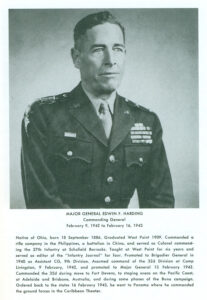 | On 9 February 1942, Brig. Gen. Edwin F. Harding assumed
Maj. Gen. Harding, a native of Franklin, Ohio, |
Brig. Gen. Albert W. Waldron, from Rockville Center, NY, was assigned
to the Division around this time as commanding general, 32D Division
Artillery.
Brig. Gen. Waldron had graduated the USMA at West Point in
‘15. He had served with the Punitive
Expedition in Mexico during the Mexican Border Crisis. He served with the 7TH FA Regt. in
France during WWI. Information about his
assignments right before his transfer to the 32D Div. has proven
elusive. [added 25 Oct. ’14, TPB]
On 10
February, Col. J. Tracy
Hale, Jr. succeeded Col. William A. Holden as commander of the 128TH
Infantry. Col. Hale was succeeded by
Col. Ben Stafford, Reg. Army, as commander of the 127TH
Infantry. [added 20 Oct.
’14, TPB]
Col. Holden was reassigned for stateside duty due to age. He had enlisted in Co. L, 3D Wis. Inf.,
Wisconsin National Guard, at Sparta, WI in Apr. ’03. He was commissioned lieutenant at some point
prior to ’12. He was 1st Lt. with Co. L
during Mexican Border Crisis. He was
Capt. and commander of Co. L, 128TH Inf., when 32D Div.
sailed for France Feb. ‘18. After
landing in France, he was transferred to 16TH Inf., 1ST
Div., while 32D Div. was briefly designated a replacement
division. He was seriously WIA and
earned the Silver Star and Purple Heart during WWI. Col. Holden ran POW camps in Western U.S. for
the remainder of WWII. [added 20 Oct. ’14,
TPB]
Col. Stafford, from Quincy, MI, was stationed at Manila, Philippines, during
WWI. He deployed to Australia with 127TH
Inf., but was succeeded as commander of 127TH Inf. before it
deployed to New Guinea. He passed away 9
Apr. ‘76 at San Jose, CA. [added 24 Oct. ’14, TPB]
Shortly after Maj. Gen. Harding assumed command,
the Division moved to Fort Devens, Massachusetts and began preparing to be
shipped to Northern Ireland.
On 18
February, the 107TH Engineer Battalion sailed from Brooklyn Navy
Yard aboard the George F. Elliott,
destined for Northern Ireland as the Division’s advance party. The unit departed sooner than originally
expected and some of its Soldiers were home on leave. To ensure that the unit sailed at full
strength, Soldiers from other Division units were hastily transferred to
it. When those Soldiers returned from
leave, they were reassigned to the units which had given up personnel to the
departing unit. [added 10 Jan. ’18, TPB]
On 25 March 1942, the Division was notified
that it was being sent to Australia to help halt the Japanese advances in the
Southwest Pacific and attempt to put the Japanese on the defensive.
The 32D Division, along with the 41ST
Division, would become part of I Corps in Australia. Maj. Gen. Robert L. Eichelberger, a classmate
of Maj. Gen. Harding’s at West Point, was the I Corps commander. I Corps had been scheduled to participate in
Operation TORCH in North Africa later in the year, until a last minute change
sent it, too, to Australia. Maj. Gen. Eichelberger had seen sudden changes of mission before (and
he would see more in the future), during World War I, when scheduled to go to
France, a last minute change found him as assistant chief of staff of our American
Expeditionary Force in Siberia, Russia.
On 9 April 1942, Bataan fell to the Japanese. All surviving members of Company A, 192D
Tank Battalion became prisoners and, along with the other American and
Philippine forces who surrendered to the Japanese, participated in the infamous
“Death March.” Over three years later,
after the defeat of Japan, the 35 remaining men of the Janesville Tank Company
would be released from POW camps and returned home. The Company had 114 officers and men when it
entered Federal service on 16 Nov. 1940.
On 10 April, the Division boarded troop trains at Fort Devens and
headed for San Francisco, the last train arriving there on 14 April. The 107TH
Engineer Combat Battalion had already sailed for Europe, so the 114TH
Engineer Combat Battalion from New England hastily took their place in the 32D Division.
While preparing to embark, the
Division picked up some 3,000 replacements, most of these had just finished
basic training (the Division was still short around 1,800 men).
On 22 April, the 32D Division sailed from San Francisco, bound for Australia,
making them the first U.S. division to be shipped overseas in one convoy.
The convoy consisted of:
Troopships:
·
USAT Ancon
(formerly SS Ancon, later became USS Ancon (AP-66))
·
USAT Argentina
(formerly SS Argentina)
·
USAT Hugh
L. Scott (formerly SS President Pierce,
later became USS Hugh L.
Scott (AP-43)): carried 632D Tank Destroyer Battalion, 114TH
Engineer Battalion, 107TH Medical Battalion, 32D
Reconnaissance Troop [according to a copy of the ship’s newsletter The Deep Sea Doodle, 11 May ‘42].
·
USAT Lurline (formerly SS Lurline): carried some or all
of the 126TH Infantry Regiment.
·
USAT Matsonia (formerly SS Matsonia)
·
USAT
Monterey (formerly SS Monterey)
·
USS Mount
Vernon (AP-22) (formerly SS Washington): carried some
or all of the 127TH Infantry Regiment.
Freighters:
·
SS
Hawaiian Planter
·
SS
Hawaiian Merchant
Escort:
·
USS
Indianapolis (CA-35)
·
Two Australian destroyers joined the convoy as
it neared its destination. [updated 19 May ’12, TPB]
It is interesting to note that the date 7 May 1942 never existed for the men of
the 32D Division. When their
convoy crossed the International Date Line, they went from 6 May to 8 May.
On 14 May 1942 the 32D Division reached Adelaide, South Australia. It was sent to Camp Woodside (east of
Adelaide) and Camp Sandy Creek (north of Adelaide).
On 1 June 1942 the 107TH Engineer Battalion
(Michigan National Guard and formerly part of the 32D Division) was
inactivated in Northern Ireland. Its
equipment and personnel were combined with that of the 112TH
Engineer Battalion (Ohio National Guard) to form the 112TH Engineer
Regiment (a Corps-level unit). The
former 112TH Engr. Bn. became the new unit’s 1ST Bn.; the
former 107TH Engr. Bn. became the 2D Bn. [updated 10 Jan. ’18, TPB]
The new 112TH Engr. Regt. wouldn’t last long. It was broken up on 12 August 1943, its HQ
Co. was redesignated the 1121ST Engineer
Group Headquarters. The 1ST
Bn. became the 112TH Engr. Bn., once again. For some strange reason the 2D Bn.
did not revert to the 107TH Engr. Bn., but instead was designated
the 254TH Engr. Bn. The 254TH
Engr. Bn. landed at Normandy on D-Day and fought through France, Belgium,
Luxembourg, Germany, and Czechoslovakia. [added 10 Jan. ’18, TPB]
In July of 1942 the Division relocated to
Camp Tamborine, near Brisbane on Australia’s east
coast. The 900-mile move from Adelaide to Brisbane was
rather difficult. Much of the Division’s
equipment and personnel were shipped by railroad (some also went by sea). Each Territory in Australia had its own
(different) rail gauge (gauge refers to the distance between the two
rails). The trains had to stop at the
border of each territory; the train was then unloaded and all the equipment and
soldiers had to be loaded onto a different train that was compatible with the
rail gauge in the next territory. The 32D
Division crossed the borders of four Australian Territories before it reached
Brisbane.
 | On 30 August, Camp Tamborine |
In August of 1942, the
173D Field Artillery Regiment, Col. Breidster, moved from Camp
Livingston, LA, to Camp Gruber, OK, where it was assigned to the 16TH
Field Artillery Brigade. It had been
organized earlier in the year, when the 32D Division was
“triangularized,” from the 2D Bns. of the 121ST and 126TH
FA Regts. [added 22 Oct. ’14, TPB]
photo added 7 Jun. ‘14 photo from collection of 
| Unit photograph Men Lying Down: Pvt. Dominig Photograph submitted by HSC Michael R. Anderson, USCG; |
Sgt. Henry Aho was from Menomonie, WI. He was a Pvt. in Co. A, 128TH
Inf., Wisconsin National Guard, at Menomonie, WI when 32D Div.
mobilized on 15 Oct. ’40.
Pvt. Leonard J. Badaczewski (Badazewski) was from Cuyahoga Co., OH. He entered active service 15 Oct. ’40 at
Cleveland, OH as Pvt. with Ohio National Guard.
Sgt. Richard L. Becker was from Dunn Co., WI. He was a Cpl. in Co. A, 128TH
Inf., Wisconsin National Guard, at Menomonie, WI when 32D Div.
mobilized on 15 Oct. ’40.
Pvt. Clyde L. Downing was from Bragg City, MO.
Sgt. Kenneth A. Drake was from Dunn Co., WI. He was a Pfc. in Co. A, 128TH
Inf., Wisconsin National Guard, at Menomonie, WI when 32D Div.
mobilized on 15 Oct. ’40.
Cpl. Lyle R. Froeschle was from Dunn Co., WI. He was a Pvt. in Co. A, 128TH
Inf., Wisconsin National Guard, at Menomonie, WI when 32D Div.
mobilized on 15 Oct. ’40.
Pfc. Roland (Ronald) P. Grossheim was from St. Louis, MO. He would be KIA on 2 Dec. ’42 near Buna, New
Guinea and earn the Purple Heart. Pfc.
Grossheim is interred at the Manila American Cemetery.
S. Sgt. Donald L. ‘Donny’ Gunvalson (Gunvaldson),
platoon guide, was from Spring Valley, WI.
He was a Pvt. in Co. A, 128TH Inf., Wisconsin National Guard,
at Menomonie, WI when 32D Div. mobilized on 15 Oct. ’40.
Pfc. John L. Halvorson was from Menomonie, WI. He was a Pvt. in Co. A, 128TH
Inf., Wisconsin National Guard, at Menomonie, WI when 32D Div.
mobilized on 15 Oct. ’40.
Pvt. Orville L. Harbison was from Oregon Co., MO. He would be KIA on 2 Dec. ’42 near Buna, New
Guinea and earn the Purple Heart. Pvt.
Harbison is interred at Myrtle Cemetery, Myrtle, MO.
Pvt. Aloysius Hieger (Alousos Heiger) was from St
Louis, MO. He would be KIA, date and circumstances
unknown. Pvt. Hieger was repatriated and
re-interred ca. Aug. ’48 at Calvary Cemetery and Mausoleum, Saint Louis, MO.
Pfc. Van W. Hill was from Craighead Co., AR and entered
service 10 Jul. ’42 at Little Rock, AR. He has
been MIA since 28 Jan. ’44 at Teterei, near Saidor, New Guinea, FOD 17 Jan.
’46. Pfc. Hill would earn
the Distinguished
Service Cross for his actions on 28 Jan. ’44 at Teterei; he would also earn the
Bronze Star and Purple Heart. He is
memorialized on the Tablets of the Missing at Manila American Cemetery and is
also memorialized at Macey Cemetery, Monette, AR.
Pvt. Link P. ‘Pershing’ Hopper was from Fornfelt, MO and entered
service on 5 Jan. ’42. He would be KIA
on 2 Dec. ’42 near Buna, New Guinea.
Pvt. Hopper was repatriated ca. Jun. ’48 and re-interred at Saint Joseph
Cemetery, Scott County, MO.
Pfc. Robert H. Ivy was from Cherokee Co., KS and entered service 8
Sep. ’43 at Ft. Leavenworth, KS. He
would be WIA and earn the Purple Heart.
S. Sgt. Allen K. Johnson, the platoon sergeant, was from
Menomonie, WI. He was a Sgt. in Co. A,
128TH Inf., Wisconsin National Guard, at Menomonie, WI when 32D
Div. mobilized on 15 Oct. ’40.
Pvt. Lawrence might be Glenn E. Lawrence who entered service 24
Mar. ’43 at Fresno, CA and would be KIA on 26 May ’45 on Luzon, Philippines. He
would earn the Purple Heart w/OLC. Pvt.
Lawrence is interred at Manila American Cemetery.
Pvt. John R. Mansfield was from Indianapolis, IN and entered
service 29 Dec. ’41 at Ft. Benjamin Harrison, IN. S. Sgt. Mansfield would be KIA on 17 Nov. ’44
on Leyte, Philippines, shortly before he was scheduled to go home. S. Sgt. Mansfield is interred at Holy Cross
and Saint Joseph Cemetery, Indianapolis, IN.
Sgt. Richard E. Randles was a Pfc. in
Co. A, 128TH Inf., Wisconsin National Guard, at Menomonie, WI when
32D Div. mobilized on 15 Oct. ’40.
T/Sgt. Leo W. Rubusch (Rubush) was from Menomonie, WI. He was a Pvt. in Co. A, 128TH
Inf., Wisconsin National Guard, at Menomonie, WI when 32D Div.
mobilized on 15 Oct. ’40. He would be
WIA near Buna, New Guinea and earn the Purple Heart w/OLC.
Pfc. Robert J. Soden was from Pepin Co., WI. He was a Pvt. in Co. A, 128TH
Inf., Wisconsin National Guard, at Menomonie, WI when 32D Div.
mobilized on 15 Oct. ’40. He would be
WIA and earn the Purple Heart.
Cpl. Virgil M. Stang was from St. Croix Co., WI. He was a Pvt. in Co. A, 128TH
Inf., Wisconsin National Guard, at Menomonie, WI when 32D Div. mobilized
on 15 Oct. ’40. Cpl. Stang
would earn the Silver
Star, date and circumstances unknown.